

It’s that time of the year again: the time I look back on what I’ve read over the past 12 months and reflect on what I loved the most, and what I want to read more of in the year to come.
I will have read over 40 books in 2023, many (most?) of them in translation, most of them by women. I choose what I read in the same way I choose what to eat – based on mood and and appetite – so I cycle through different genres, forms, styles, and lengths of books throughout the year.
In 2023, it looks like my favourites shared some patterns – in terms of form, I have favoured the short story, the epistolary, the fragmentary, the elliptical. In terms of style, I have loved the poetic. As for themes, my heart has gone to displacement and migration, love and loss, and resilience in the face of adversity.
It’s not quite the end of the year yet, so there’s still time find more favourites but looking at my book diary so far, there are a few books that stood out over the months, and below are my “top 5,” in the order in which I read them.
There are many other books I could recommend, but these 5 were the ones that would make me say “if you don’t read anything else in the next 12 months, read this.”
1. My Pen Is the Wing of a Bird: New Fiction by Afghan Women (MacLehose Press, 2023)

This is the first anthology of short stories by Afghan women to ever be translated into English from Pashto and Dari, and it was published in 2022 as part of the UNTOLD project, a programme whose aim has been to support and amplify the voices of “writers marginalised by social, geopolitical or economic isolation, particularly those in areas with recent or ongoing conflict.”
This was the first time I ever picked up a short story anthology and, when I was done reading it, realised I had loved every single story featured. There is not one story in this book that is not skillfully crafted, poignant, and beautiful. These are all tales of resilience that foreground the importance of access to education and information, and that show how worthwhile it is to keep on fighting for freedom of thought, of expression, of choice, of the right to learn.
There is no “authors’ bio” section in My Pen Is the Wing of a Bird, since revealing that kind of personal information would have been much too dangerous for the writers featured therein. Many of the names signing these stories are pen names, for the same reason. Some of the writers featured were writing and sharing stories for the first time.
Not being able to find out more about each of these writers left me with a sense of loss and grief – I hope each of them is able to continue on their writing journey in a world where it is already hard enough to make your voice heard as a writer, and I hope we will, in the future, have the opprotunity to read a lot more of their absolutely stunning work.
I picked up My Pen Is the Wing of a Bird at the Hare and Hawthorn Bookshop in Hastings back in April.
2. Flights by Olga Tokarczuk (Fitzcarraldo Editions, 2023, 9th ed.)
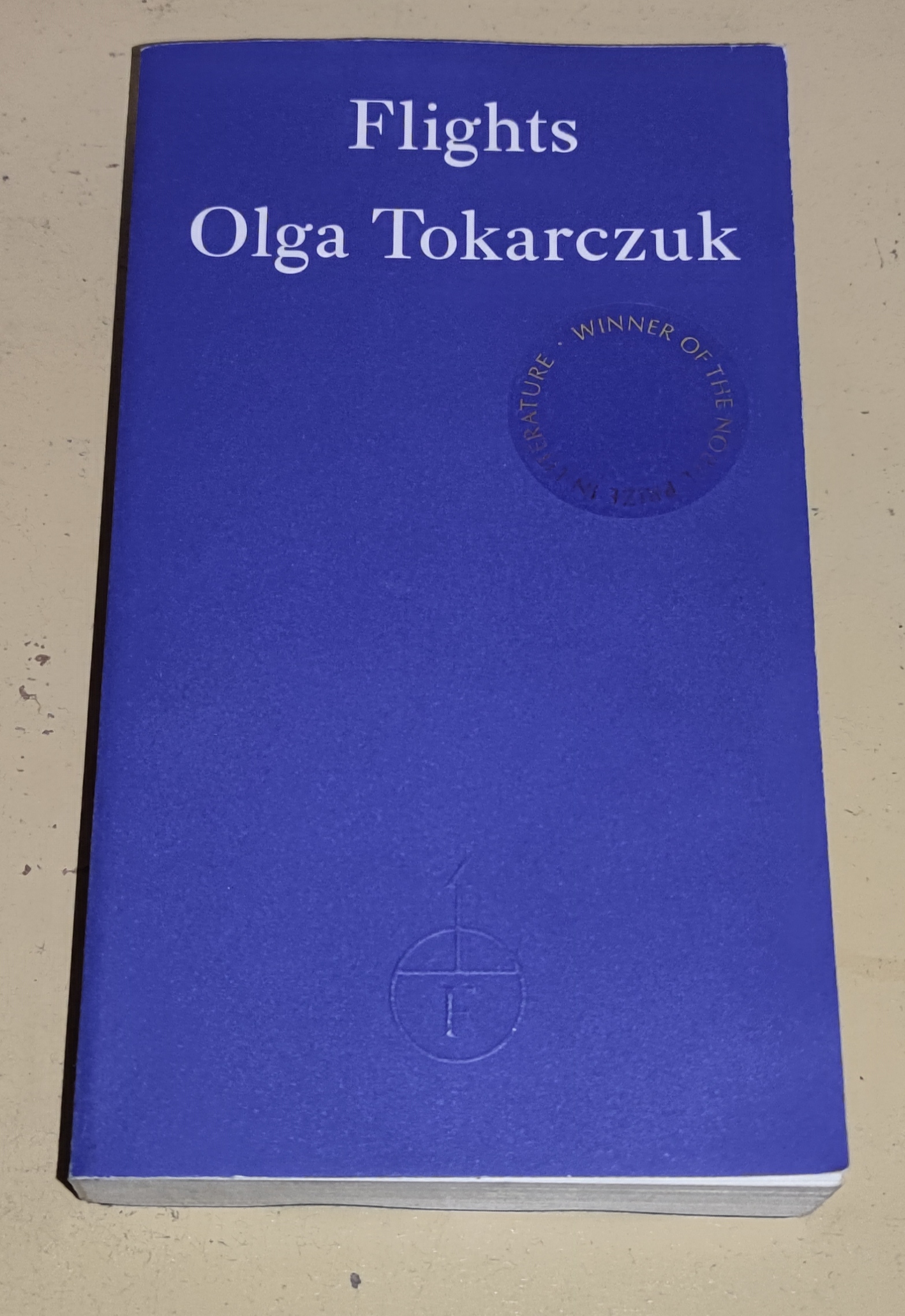
Flights is a novel like no other. Made out of narratives purposefully broken into fragments and intercalated like the pieces of a great puzzle, this unusual, nonlinear, atemporal novel tells the story of a need: the need to escape, to travel, to run away from others and from oneself only to better reconnect with others and with oneself.
“Each of my pilgrimages aims at some other pilgrim. In this case the pilgrim is in pieces, broken down.”
– Olga Tokarczuk, Flights, trans. Jennifer Croft
At first I wasn’t sure how to read it, or whether the narratives were connected in any other way but through their themes, but slowly the pieces came together, and I could see the tapestry that Tokarczuk had patiently been weaving. Through narratives set in different countries and many different times in history, she effectively turns the reader into a traveller through space and time, forcing us to embody, at least while we’re reading this novel, the spirit of its message: movement and change are necessary. We cannot, should not try to be static.
As always, her deeply poetic style adds to the experience, so this book ends up reading as a kind of lyrical ballad – we are all heroes on a quest, though we may not know what the quest is yet, and we may not know we are heroes.
“Enormous airports assemble us together on the promise of connection with our next flight […] Once they were in the outskirts, supplementing cities, like train stations. But now airports have emancipated themselves, so that today they have a whole identity of their own. Soon we may well say that it’s the cities that supplement the airports […] It is widely known, after all, that real life takes place in movement.”
– Olga Tokarczuk, Flights, trans. Jennifer Croft
I also bought Flights back in April, when I was briefly in Hastings, though from the lovely little Hastings Bookshop.
3. Glimpse: An Anthology of Black British Speculative Fiction (Peepal Tree Press, 2022)

2023 must have been the year of wonderful short story anthology finds, because this was another one where I enjoyed every single story featured, no exceptions. The breadth of themes, styles, imagery was impressive and an absolute joy to experience.
Some of the writers, like the super-talented Irenosen Okojie (author of the short story collection Nudibranch, another favourite read this year), I was already familiar with. Many other writers were new to me, and it’s always great to find new favourites to look out for.
There are stories, like Joshua Idehen’s “Green Eye,” that leave you reeling – perfect reflections of the impact (present and potential) of socioeconomic inequality, racism, and consumerism, and a stark warning of what the future may come to look like.
Then there are stories like Patricia Cumper’s “Skin,” an imaginative exploration of Black femininity, of the subtle effect of an ageist society on women, and of the sacrifice it takes to remain loving and kind in a society only too eager to portray some of us as abject and monstrous.
And finally, tales like the incredibly inventive “The Fall of the House of Penrhyn,” by Peter Kalu, a modern Gothic tale that reckons with the long shadow of slavery and white supremacy.
I found out about this anthology thanks to social media posts by one of my favourite independent bookshops in Brighton, Afrori, where I also bought my copy from (a copy signed by three of the authors featured in the anthology, no less!). Afrori is the only (?) Black-owned independent bookstore in the U.K. that specialises in books by Black authors, winner of the British Bookseller of the Year 2023 prize, and Brighton Business of the Year.
4. Written on the Body by Jeanette Winterson (Jonathan Cape, 1992)
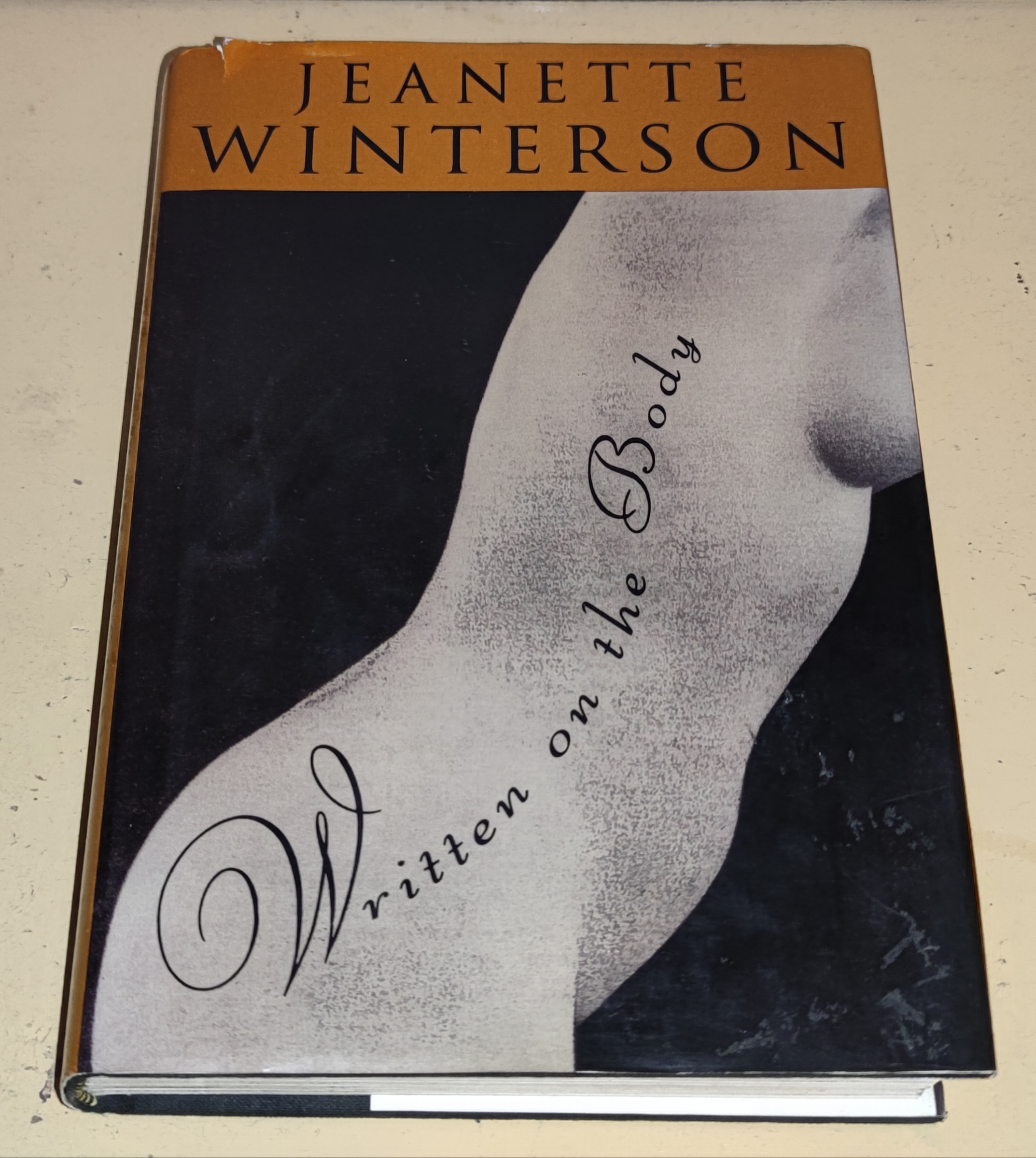
I found this beautiful first edition of Winterson’s Written on the Body at a local charity shop, and I immediately picked it up. Here is where I must shamefully confess that I had never read a Winterson book before – her stuff had been on my “to-be-read” list for ages, but as it is often the case with books that become canonical in a sense, I keep postponing the time that I’m going to read them as more and more new finds keep grabbing my attention.
So it was lucky that I happened to stumble upon this novel when I was casually browsing the book section of a local charity shop – because I then did what I do when I go in “blind” at any bookstore: I opened the book at random and tried to get a “taste” of it by reading a random paragraph or two. And what a delight! This is by far one of the most poetic books I’ve read this year, where every sentence, every section reads like a snatch of a song.
It’s a novel about the fragility and complexity of love, and the immensity of loss, about betrayal and self-betrayal, and the heavy impact of choices made for ourselves and for others, without their input or consent. The first-person narrator, unnamed and purposefully ungendered, maps out the ins and outs of complicated romantic intimacy in delicate and painfully raw pen strokes. It’s the kind of book that makes you want to hold your loved ones closer and tighter.
“Why is the measure of love loss?
It hasn’t rained for three months. The trees are prospecting underground, sending reserves of roots into the dry ground, roots like razors to open any artery water-fat.”
– Jeanette Winterson, Written on the Body
Starting my forray into Winterson’s works with this book was a serendipitous act. I’m very curious to see how some of her other books will measure up to this one.
“Night flying I know exactly where I am. Your body is my landing strip.”
– Jeanette Winterson, Written on the Body
5. Sylvia by Maithreyi Karnoor (Neem Tree Press, 2023)

“When things lack names in a new language, they are lent the names of others that are the closest fit. Like borrowed pyjamas when one stays overnight with a friend one is visiting for dinner. It means the drink and the conversation lasts longer than expected. The ill-fitting clothes are markers of a happy time.”
– Maithreyi Karnoor, Sylvia
This gem of a book, set primarily in Goa, can be read two ways: first, as a novella split into 10 chapters with distinct plots and characters that are connected very subtly by their themes and the fugitive image of the character that lends her name to the title. Second, it can easily be read as a collection of short stories connected loosely by characters that are the main figures in one story, and then appear only very briefly and enigmatically in others. Perhaps it is meant to be read both ways, and I love to think about it both ways.
Through its brief chapters/ short stories, the book is an exploration of the fragility of relationships and of human life, at the same time that it puts forth the message that (co)incidental encounters have the potential to change the course of a life or a story. In short, all human lives are interconnected, forming a subtle web of complex and unconscious influence.
Not only did I love the inventive form of this book, the themes it tackles, and the messages it sends across, I also loved how skillfully it weaved the atmosphere of Goa, through landscapes, the description of foods, the reference to folk tales. I’ve never been to Goa, but as I was reading this book, I kept thinking how much I want to go, to savour the atmosphere the book hints at – not an idealised environment, by any means, but a culturally rich one.
The book also features a glossary of terms at the end – helpful, for sure, but perhaps not 100% necessary, as the context usually made it pretty clear what many of the original terms were referring to, whether it was an item of clothing, a type of food, or a form of address. This made me think of how Anglo- and Western-centric publishers and/or editors often are, worried that a U.K. or U.S. readership won’t be able to connect with anything too “foreign.”
And here concludes my little listicle. Again, while these were not my only favourite reads this year (and indeed, the book I’m reading at the moment will probably make it to my top 10, easily), these were the books that I still think of often, looking back on 2023, the books that I feel have changed or shifted something in me for the better.
What were some of your favourites this year? And any new books I should keep an eye out for in 2024?
 Encyclopaedia Vanitatum