

I went to Spain for the first time recently – it was a truly wonderful holiday, even better than expected. The sights were delightful, the food delicious, and the people friendly and accommodating. I spent a week there, looking at things through the eyes of a traveller, and here is what I saw.

First, that the choice of language matters. Here’s what I mean by that. I understand quite a lot of Spanish – maybe 80-90% of it, both hearing and reading it. However, while I do speak some of the language, I’m in no way proficient – I’ve never actively used it, and I’ve picked it up largely by immersion, by watching a lot of Latin American telenovelas with my mum and grandma when I was little, and thanks to the fact that I’m already a native Romance-language speaker, which makes picking up other Romance languages easier, more intuitive. My four years of intensive Latin in high-school must also have helped keep those language muscles in shape. Anyway, on my recent trip I had ample opportunity to put my little knowledge of Spanish to good use, and I noticed the difference in people’s attitudes. Everyone, and I mean everyone – shopkeepers, museum staff, front of house staff in eateries – truly appreciated that I was making an effort to communicate in Spanish, despite the obvious fact that my vocabulary and grasp of grammar were limited, I made many mistakes, and I was very slow in finding my words sometimes. In fact, on the handful of occasions when I switched from English to Spanish, I could see my interlocutors’ expressions changing: they immediately ligtened up, smiled more, became (even) friendlier. Everyone was so encouraging and patient with me as I conversationally stumbled my way through their language, that I found it much easier to shed my typical embarrassment at speaking a foreign language I don’t master. I could tell my efforts were welcomed enthusiastically, which made me feel enthusiastic about trying, and learning more. I could also tell that people were most likely tired of being cornered into speaking English to English-speaking-only tourists, and I found that fair. The whole thing renewed my motivation to practice my other languages, the ones I’m not proficient in, more and more often, and to make more of an effort to get out of my linguistic comfort zone when I’m travelling. It’s very easy to throw English, the current lingua franca, around and expect everyone to understand me, but it’s not fair and perhaps not very respectful to rely on it to that extent, especially when I have other languages at my disposal. Learning languages is an important tool, and if we have the means, we shouldn’t stop at learning just one.
My first takeaway message to those who are reading this is: take those extra language classes, brush up your knowledge of the languages you learned in school, read magazines in other languages. Do whatever it takes to get over that island mentality and work towards becoming a “citizen of the world.”
Second, I found that “where are you from?” is not a worldwide obsession. This was a refreshing observation, having had more “where-are-you-from”s thrown at me by random strangers in random contexts just before leaving for my holiday. Despite the fact that I spoke Spanish with a very strong foreign accent, despite the fact that my knowledge of the language was clearly limited, not one of the people I spoke Spanish to made me feel excluded or embarrassed by asking me where I was from, where my accent was from, or how I had come to learn the language. In Britain, I get this question from shopkeepers, random people at the bus stop that I’ve barely exchanged two polite words with – you name it. In Spain, I got it maybe two or three times when I bought museum tickets – and every single time, the staff member asking the question explained, apologetically, “it’s for data-collecting purposes.” They looked and acted like they understood it was an invasive question. They didn’t linger on it. They were apologetic about having to ask it. So far, I have not encountered this anywhere else, least of all in Britain, and I repeat that it was a refreshing experience. It also reinforced the notion that: a. people know how to mind their own business when they want to, and b. you can ask any number of other questions if you really feel like making small talk with a stranger.
My second takeaway message: light conversation is possible without asking people invasive questions, including “where are you from?”.
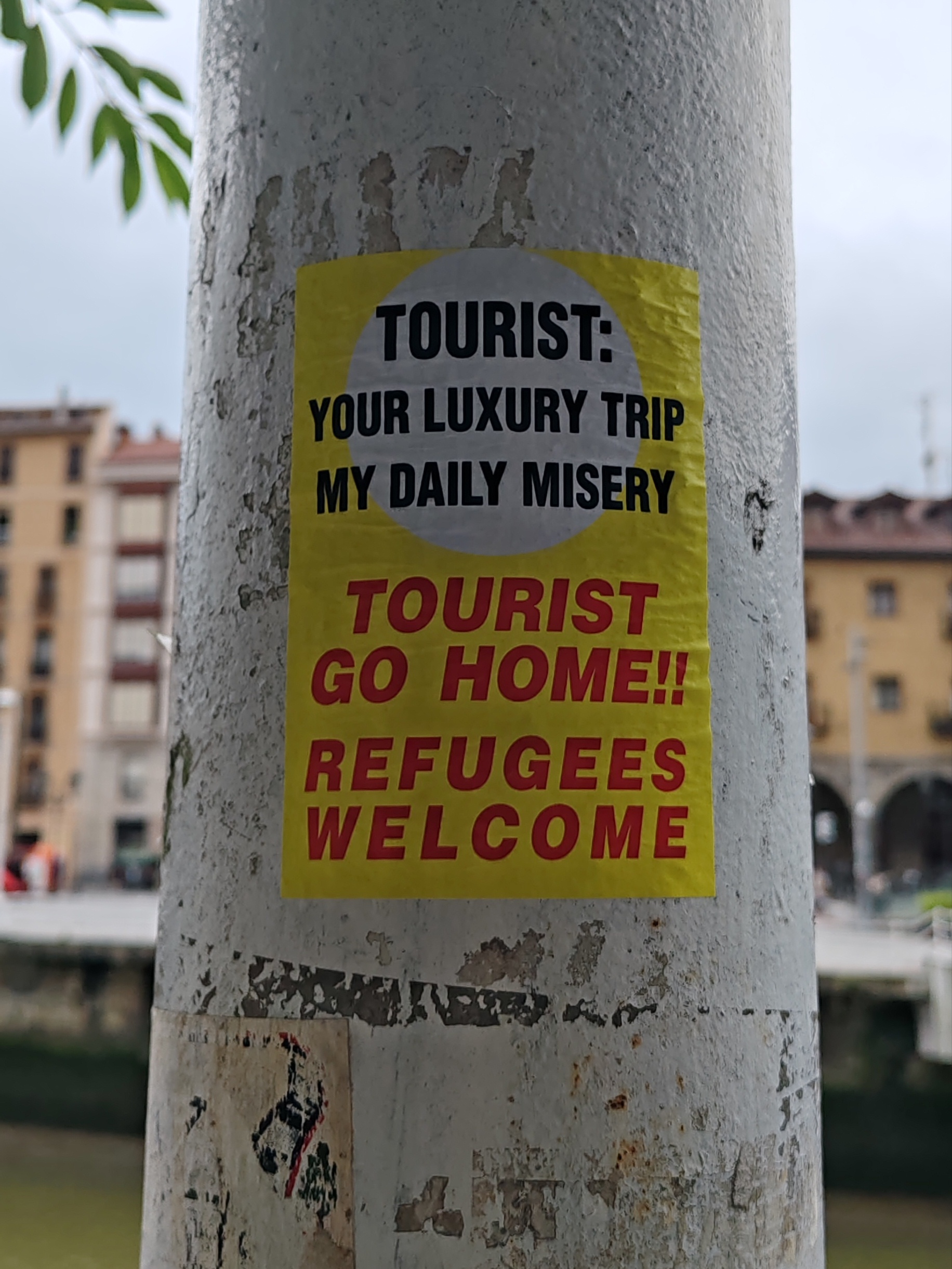
My third and final observation: white male English tourists travelling in packs are vile. And I can only call them “packs” – those large groups of more than five white English men, in their 20s and 30s, perhaps there for a stag do. They wear ridiculous outfits (a Union Jack tank top, tiny shorts, and red latex booties, really?), order dozens upon dozens of alcoholic drinks, and are the loudest, most obnoxious, most disruptive people for miles around. I had the misfortune to sit down next to one of those groups when I was having lunch one day – they were the only screaming people in the whole place. Later, after I’d left, I could still hear them shouting from across the bridge – yes, I had crossed a whole bridge, I was on the other side of a rather large canal, and I could still hear them. These are the people that make me the angriest when travelling – loud, disrespectful, seemingly only there to get drunk, thinking the world revolves around them, treating the whole place like their personal theme park, choosing to disregard the fact that other people actually live there. I say this from the bottom of my heart, with my whole chest: I hate the loud packs of white male English tourists. These are the kinds of people who know how to wolf-whistle and be loud at all times of day and night, and yet will stay quiet if their buddy harasses a woman on the street, or if they witness another man being abusive to someone else. If you confront them about that, they will always make excuses. No wonder there have been so many recent protests against mass tourism in Spain. I get it. The day I sat next to the loud pack I felt embarrassed that I, too, was a tourist from England. This kind of behaviour, this selfish and disrespectful attitude to travel reflects badly on the rest of us, too. I have nothing to say to men who choose to be part of this harmful bro culture, who take up too much space (literally and metaphorically), who treat the world like their oyster but they’re too scared or too laissez-faire to speak up against gender violence, racism, or other forms of discrimination or agression.
My final takeaway message: journey through the world more quietly, tread with respect, pay more attention to the things and people around you, and choose to be loud only when raising your voice matters, when it will actually make a positive difference to someone.
 Encyclopaedia Vanitatum