

These past few years, I’ve made it a mission to keep a diary of books read per year, and every December, I take great pleasure in looking back on my 12-month reading history.
According to my diary, in 2024 I read or reread a total of 43 books – including novels, graphic novels, nonfiction books, short story collections and anthologies, but excluding poetry pamphlets and collections, which I tend to read in a less systematic manner, picking them up and putting them down as the mood dictates, sprinkling my reading life with poetry, as it were.
I read books in three languages – English, Romanian, and French – from 15+ countries, including: Austria, Canada, Czechia, France, Germany, Hungary, Japan, Nigeria, Poland, Romania, Russia, Singapore, South Korea, the U.K., and the U.S. Many, possibly most of them were in translation (English or Romanian), and most of them by women (this seems to have become a theme of my reading preferences).
I’m not even going to attempt an in-depth discussion of all the books I liked, and all the ones that let me down – it would take me another year! Instead, I’ve taken some pains to try and pick just a handful of books in different categories that I really enjoyed in the past 12 months, and which I would highly recommend, and one single book that really let me down, and I’ll explain why.
Also, please keep in mind that I’m only listing books that are available in English.
Best novel: It was really hard to pick just one book for this category because in all honesty, I read several absolutely brilliant novels in 2024. Parasol Against the Axe by Helen Oyeyemi, published by Faber last February, is probably one of the best books about a city (or rather, impersonating a city) that I’ve ever read. She hasn’t captured, but rather released the spirit of Prague in its whole complex and contradictory glory, and anyone who’s ever spent more than two days at a time in Prague and reads this book will immediately feel it in their blood.
Then, The Empusium by Olga Tokarczuk coloured my autumn every shade of red. In English, it was translated by Antonia Lloyd-Jones for Fitzcarraldo Editions, and published last September, but I read it in a Romanian translation by Cristina Godun, published by Polirom in May last year. Generally speaking, while I don’t speak or read any Polish, it seems to me that the Romanian translations of Tokarczuk’s oeuvre do a better job of capturing the original lyricism and what I believe to be the atmosphere the author weaved in the original language, hence why I tend to seek her books out in Romanian. In any case, The Empusium is so much more than a “health resort horror story” (or a “naturopathic horror story”, as the Romanian translation has it), as its subtitle suggests. It is also plenty more than just a response to, or a rewrite of Thomas Mann’s The Magic Mountain, while it is clearly in conversation with it. (And The Empusium‘s translations were released last year on purpose, to mark 100 years since the publication of Mann’s novel.) Tokarczuk’s novel meanders through issues of gender-motivated violence, imposed gender roles, questions of sexual orientation and, in true Tokarczuk fashion, environmental concerns, to create a story where the “fittest”, those who survive and thrive, are those who challenge the patriarchy and its norms.

But I really wanted to foreground Strangers by Taichi Yamada, which I read in Wayne P. Lammers’ translation for Faber (2023 edition), which took me by surprise. I read this book last February, in preparation for watching All of Us Strangers, the film by Andrew Haigh that had recently been released, and whose plot (I can now confirm) is very loosely based on, more like inspired by, Yamada’s novel. Going in with confused notions about the storyline and atmosphere, which I had gathered from the film trailer, nothing prepared me for what Yamada’s novel was actually like. While it does nod to same-sex, romantic male-male relationships in the beginning, it does not actually deal with queerness, like Haigh’s film. What it does deal with, and very strikingly at that, is the issue of urban isolation – people whose lives are so encased in loneliness, sometimes self-inflicted and sometimes not, that they become all but tragically unknowable. Strangers interweaves fairy-tale and ghost-story elements to paint a multi-layered picture of longing, particularly longing for affection, for being known, and for being remembered kindly and with love. The plotline has the throbbing crescendo of a horror story, but its ending is almost gentle, a tender heartbreak. Like most novels that I fall in love with, Strangers doesn’t fit one genre; instead, it uses aspects of many to convey a powerful message. As a side note, I wouldn’t fall into the trap of comparing it to Haigh’s film: while it pays loving tribute to Yamada’s novel, All of Us Strangers is its own story, a different kind of story that makes different choices, and it deserves being weighed and contemplated on its own.
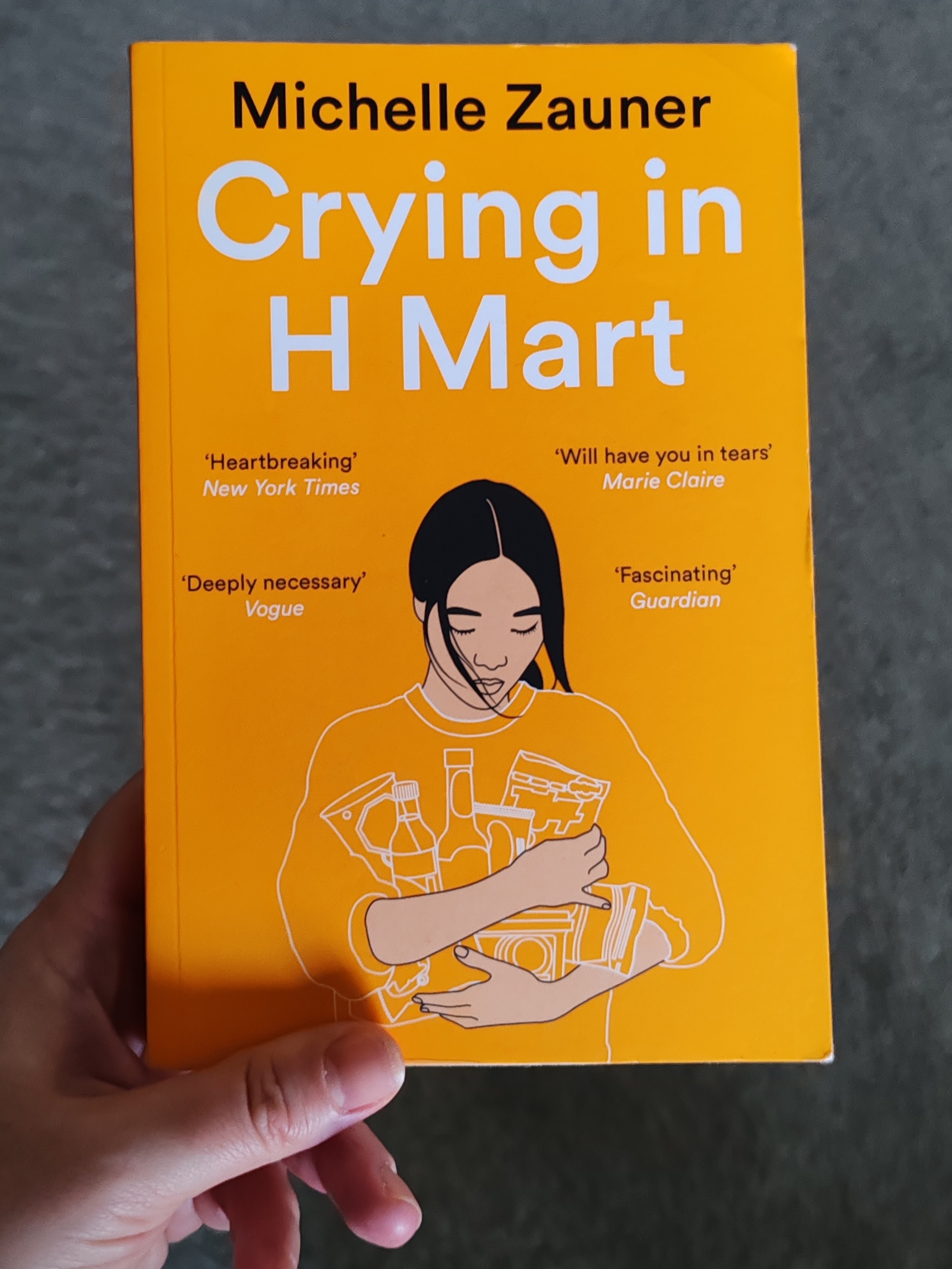
Best nonfiction book: I read a few nonfiction books last year, all of them worthwhile, but the one that really stuck with me was an autobiography, Crying in H Mart by Michelle Zauner (Picador, 2022 edition). This book had been on my reading list for a long time, ever since I read an excerpt of it in The New Yorker in 2018, in fact. Zauner is a Korean-American of about my own age, who has made a career as a musician. Crying in H Mart is a meditation on her complicated relationship with the two sides of her cultural identity, with her family, and especially her mother, whose untimely death Zauner grieves – candidly and in slow, pain-filled strokes – in this book. The autobiography chronicles key moments from her childhood, adolescence, and young adulthood, the development and breakdown of relationships with many loved ones, and her complicated relationship with her Korean mother, most of all, to answer, as it seems to me, the questions: “Who am I, who can I be, and who will I dare to be?” Much of her self-reflection and her exploration of relationships with others is conducted through the lens of food and eating, which comes across as an apt metaphor for how our cultures and relationships can nourish us, and how we can grow through the shared experience of cooking and eating together. Raw and emotional, this journal of Zauner’s journey through grief and towards self-acceptance made me tear up on trains, planes, and in hotel rooms. It’s one of those books I wish I could forget only so I can experience it again like I did the first time.

Best poetry collection: While I did say I didn’t count poetry books in my book diary, I still read a few this year, and I wanted to mention the one that left a special mark: Shadow Reader by Imtiaz Dharker (Bloodaxe Books, 2024). I read this poetry collection in almost one sitting, one autumn afternoon in London, most of it in the quiet hum of a café, and the rest somewhat awkwardly, sharing a tall pub table with a group of loudly chatting strangers. I say “awkwardly” not because I’m in any way embarrassed to read poetry at a pub, but because I was struggling to hold back tears while reading this book. As I mentioned at the start of this blog post, I tend to read poetry books in a haphazard manner, dipping in and out – and they do lend themselves well to this type of experience, allowing us to peck at them when the mood strikes. This collection, however, was unputdownable. With slow determination, it weaves a cohestive story: a story of survival, of coming to terms with a world that is often violent, an oppressive, supremacist world that threatens to erase the Othered. It is also a story of transcending that violence and that sense of rejection, a story of making peace and persisting in living a meaningful life in the midst of chaos. The collection begins with a threatening prediction:
“When I was twenty-five
the Shadow Reader said
I would live to a ripe old age.He licked his finger, flicked a page
and told me the year of my death.
That year has arrived.”– “In the Year of My Death”
It ends with a promise, and with determination:
“My walk is iambic. I keep the beat.
[…]There’s comfort in knowing
that as long as the stress is in the right placeand as long as I keep up the pace
it doesn’t matter where my feet are going.If I can hear the iamb of my heart I’m not dead
yet. My walk is a sonnet.[…]”
– from “I Walk in the Shadow”
In-between, there are hard poems that are difficult to swallow – about war, forced displacement, and all types of violence (“Next”, “For the girl whose hair escaped”, “Away”, “There are no words”) – as well as soft poems that welcome you home (“The key”, “Night Walk with Lit Windows” “Sweeping”), and funny-sad poems that leave you half-smiling (“Swiping Left on Larkin”, “In Which I Am Ghosted by William Blake”). The illustrations, featured at key points in the collection, are also Dharker’s own, and form part and parcel of this lyrical story, perfectly complementing the poems they sit next to. But this book isn’t just a self-exploration of the poetic voice therein; it is an invitation. Several poems directly invite the reader to step in, to make themself at home in this world that, while troubling, also freely offers sanctuary to those who seek it – an extension of our own world where, as that excellent Mary Poppins song has it, “there’s things half in shadow/ and halfway in light”. Halfway through Shadow Reader, there’s a short, four-line poem called “Reader” that sums it all up:
“You come to the books
to take you away, but they
open to welcome you home
and you stay.”
Some part of me has gladly chosen to stay between the covers of Shadow Reader.
Best short story collection and best short story anthology: I am a huge lover of short stories. There’s something about this “snapshot of life” format that really appeals to me: that notion of having something precious that’s perfectly contained yet ready to burst any minute. Every year, I find myself reading a lot of short story collections and anthologies, and last year was no different, so here’s my favourite of each.
The short story collection I most loved was one that I was lucky enough to receive a review copy of: Bluebeard’s First Wife by Ha Seong-nan, translated from the Korean by Janet Hong for Open Letter (2020). You can read my extensive (perhaps overly so!) review of it for Cha on their blog, so I’ll be brief. These eleven stories are essentially fairy-tale dissections: they delve deep into current and also timeless societal issues, and all the many forms of “banalised” evil that we can encounter, from freak accidental deaths to abuse of power, child neglect, and murder. While they use and reimagine various fairy-tale elements, Ha’s stories, on the whole, refuse us the comfort of happy endings in favour of the more important task of leaving us with hard questions to ponder, chiefly: “How has evil become so banal, and why have we allowed ourself to become desensitized to it?”

As for anthologies, one in particular has stood out to me: A Cage Went in Search of a Bird (Abacus Books, 2024), which features stories by the likes of Ali Smith, Naomi Alderman, Helen Oyeyemi, Yiyun Li, and Leone Ross, and which commemorates a hundred years since Kafka’s death. The anthology title itself comes from a phrase penned by Franz Kafka in his intriguing Blue Octavo Notebooks (which I also read in 2024, in a reprint of an Exact Change edition from 1991), and it is an excellent choice of title. All the stories in it, whether written to prompt or simply matched to prompt, are meant to be Kafkaesque in spirit. Some of them also build on quotes or fragments from The Blue Octavo Notebooks. According to my notes at the time of reading, my top favourite stories from this collection were, in the order in which they appear in the book:
- “The Board” by Elif Batuman, a strange and somewhat comical story of a bizarre flat viewing that descends rapidly into the grotesque and the absurd, definitely very Kafkaesque.
- “God’s Doorbell” by Naomi Alderman, an intelligently written story with a sci-fi bent that explores the notion of hybris/ fall from grace through the lens of the relationship between humans and AI entities. Inspired by a passage from The Blue Octavo Notebooks: “If it had been possible to build the Tower of Babel without climbing it, it would have been permitted.”
- “The Hurt” by Tommy Orange, a deeply troubling story, with pandemic undertones, plumbing the depths of unknowable human pain, and our desperate need for connection.
- “The Landlord” by Keith Ridgway, an eerie tale about power relations and what it might take to tip the balance – of power, and sanity.
- “Headache” by Leone Ross, a writer I greatly admire, was absolutely splendid and truly haunting in its exploration of a diseased, disturbing, and deeply racist medical system.
- “This Fact Can Even Be Proved by Means of the Sense of Hearing” by Charlie Kaufman, was the final story in the anthology, and an excellent one to end with. The entire story built on another passage from The Blue Octavo Notebooks, perhaps the one that also stuck with me the most because it is so disturbing yet it rings improbably true: “Everyone carries a room about inside him. This fact can even be proved by means of the sense of hearing. If someone walks fast and one pricks up one’s ears and listens, say in the night, when everything round about is quiet, one hears, for instance, the rattling of a mirror not quite firmly fastened to the wall.” Kaufman’s story is cinematic, and it strikingly portrays the dissolution of a mind – though whose mind is coming undone may be something to ponder.
Most disappointing book read in 2024: As usual, there were a few books that didn’t really do much for me, but one in particular felt like a huge disappointment and rather a waste of time, I’m sorry to say. This was a debut novel that received rave reviews when it was first released, and even made it into the Sunday Times bestsellers list. I’m talking about The Cloisters by Katy Hays, which sits somewhere between a detective novel and a thriller, with some romance and snippets of art history thrown in. Last year, it was finally released in paperback, and there was clearly a strong marketing effort behind boosting its sales numbers again. The book appealed to me because it had been described as “Gothic” and deliciously peppered with art history facts, because the plotline revolves, tantalisingly, around a mysterious deck of ancient tarot cards, and because it’s set in the beautiful Met Cloisters in New York. Yet something kept holding me back from buying it – I kept wondering whether or not I’d actually enjoy it, whether it was really worth the hype. Eventually, I bought a used hardback copy for a few quid at a local charity shop because it was so cheap. I had really high expectations going in because the novel actually starts with a beautifully crafted first sentence that immediately pulls you in: “Death always comes to me in August.” The first couple chapters or so were pretty decent, and did a good job of setting up the eerie, pleasantly threatening atmosphere. It was all downhill from there though: terrible and stereotypical character construction, a superficial and annoyingly stereotypical “frienemy” relationship between the two main female characters, superficial and (again!) stereotypical presentation of academic types and environments, and a truly chaotic, all over the place plot, with a resolution that, by the time it comes around, is utterly unsurprising and even a little boring. I donated the book again straight after finishing it. I’m sure someone else will find it more entertaining, but all it did in the end was annoy me. This book has been compared to Donna Tartt’s The Secret History but it’s more like a shabby, poorly plotted version of Dan Brown’s The Da Vinci Code (!) with (bonus!) murderous academics on the loose.
That’s it for reviews! Before I go, here are my reading resolutions for 2025: to read in more languages, to read even more broadly, and to read nonbinary/trans authors. Leave me your recommendations, and let me know what your favourite (and least favourite books) were in 2024.
 Encyclopaedia Vanitatum