

I first got the idea for this blog posts a few months ago, and it surely would have been quite a different kind of post, had I written it then. So much has happened since then that has now altered the flow of my thoughts, and the framing of my original idea.
I am writing this on a lunch break, in a brief moment of quiet that I have carved out within the chaos that currently surrounds us. I am at the Brighton Museum and Art Gallery, sitting on a bench in my favourite exhibition, called Our Ancestors. The exhibition offers a glimpse into what the lives – and deaths – of people inhabiting the territory of Brighton and surrounding areas in East Sussex might have been like from the Ice Age up until Saxon times. My favourite part of the exhibition are the facial reconstructions displayed here, of seven people whose remains have been found in digs in Brighton and around East Sussex. The reconstructins are truly phenomenal – so lifelike that it feels like each of them might soon break the silence to recount their true life’s story.
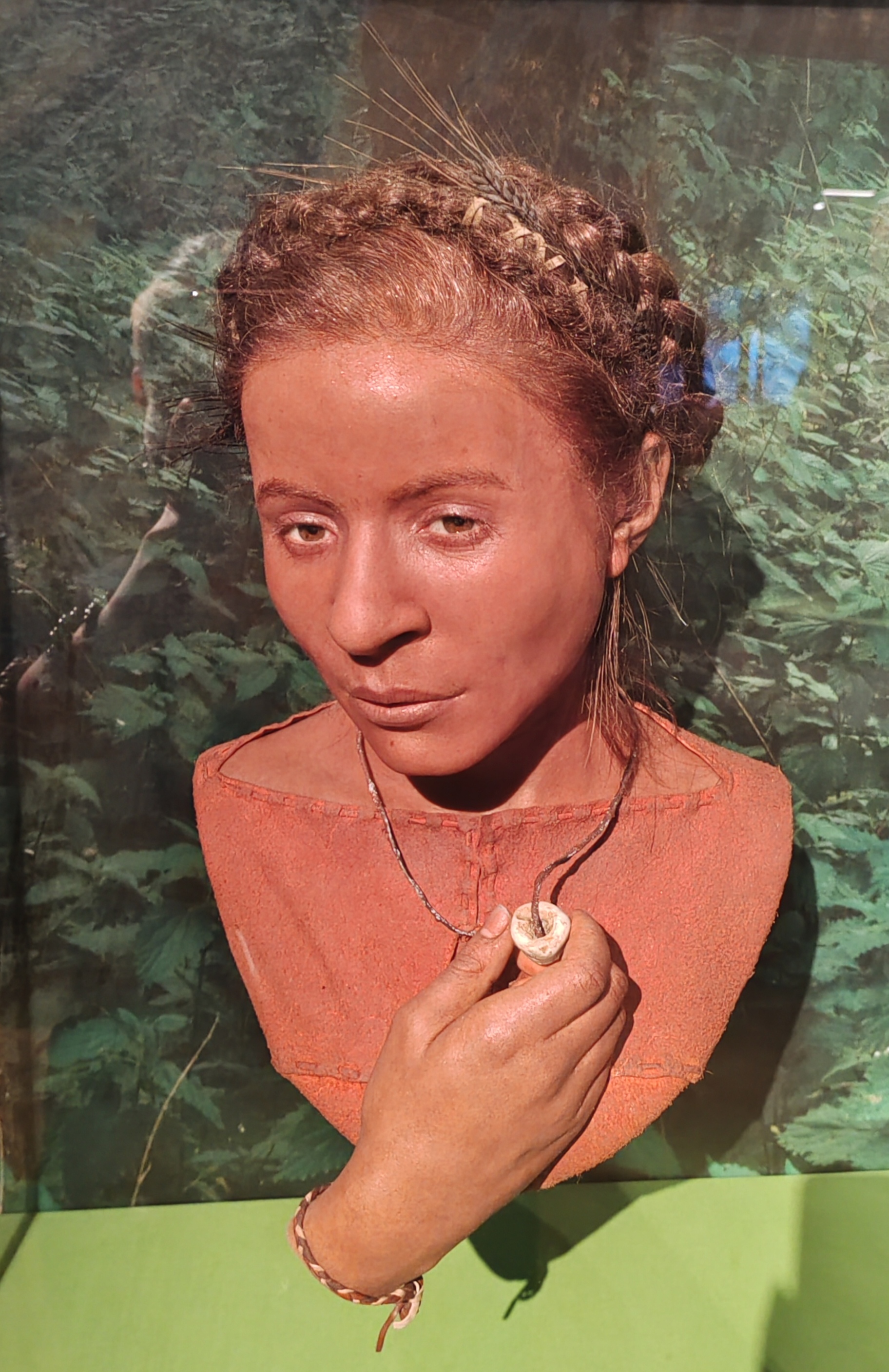
Every time I come here, I spend long minutes gazing at the face of the Whitehawk Woman, so nicknamed after the place where her body was discovered, at the Whitehawk Camp, near Brighton. Carbon dating suggests that she lived 5,650-5,520 years ago, in the Neolithic, and she most likely died very young, in childbirth, as she was buried cradling the fragile body of a tiny baby. The facial reconstruction pictures her as dark-skinned, with soft brown eyes and curly brown hair in a long plait gathered round the top of her head like a crown. The paleoanthropologists who studied her remains surmised that she may have grown up in Herefordshire, Brittany, Normandy, or the Iberian Peninsula – yes, any of those places might have been her place of birth, even though her life ended in what is now the heart of East Sussex.

From a glass case not far from the Whitehawk Woman, the Ditchling Road Man gazes back at museum visitors, his face set in a witsful expression. By contrast with his neighbour, he has very pale skin, long, strawberry-blonde hair partly hidden under a woolen cap, and sad but piercing blue eyes. Carbon dating places him 4,287-4,125 years ago, and his burial was all valour and poetry. “An arrowhead was placed under his head and snail shells in front of his mouth”, the museum label reads. It also tells us something else that immediately draws our attention, namely that “he was one of the new wave of metalworking people from Europe.” He may have originated in what we today know as France, or Belgium.
And so, I sit here looking at these people, wondering about the course of their lives, of which we have no record but what diet, weather, and work inscribed on their bones. Their presence here, their remains demonstrate one thing for certain: all of us, yes, all of us are, originally, from somewhere else. Populations have always been in motion. Like so many other animals, humans, too, are naturally migratory. Since times immemorial, as the saying goes, people have moved around – out of curiosity or necessity, to forge better lives for themselves and their loved ones, and to learn about their place in the world.
The memory of migration may have been lost over generations but I can assure every single “patriot” out in the streets wreaking havoc these days, or wrapping themselves in flags, that they, too, come from migrants. Maybe generations back, the mother of their mother’s mother’s mother’s mother’s mother was a refugee, someone who sought safety and peace in a land other than that where they were born.
The people whose faces we see recreated in Brighton Museum’s Our Ancestors exhibition show us another thing, too – that people inhabiting these territories, or I should say, coming to inhabit them have always been diverse. They have been diverse in appearance and, no doubt, diverse in their beliefs and their practices. There is no one, true Briton.
Here’s a question to everyone from everywhere who calls themself a “patriot”: what exactly are you proud of, in your patriotism? You love your patria, which is the Latin word for “country of birth”, literally, the “land of your fathers” but do you know who your forefathers were? Take a dozen steps into Brighton Museum, or any museum, for that matter, and you will find that you are only here because someone, at some point, was brave enough to cross lands and seas and build a home in a foreign land.
Who, exactly, do you think you are?
 Encyclopaedia Vanitatum