
Let’s talk about one of the strangest, creepiest literary landmarks of Romania.
About an hour and a half’s drive north from Bucharest, lodged among the hills, lies the rather sleepy town of Câmpina, once upon a time a key transit point on the commercial route linking Transylvania, the mountainous northern region of what is now Romania, to Wallachia, the southern principality spreading over the plains and hills. At the turn of the century, Câmpina attained the peak of urban development as it became an important oil extraction centre.
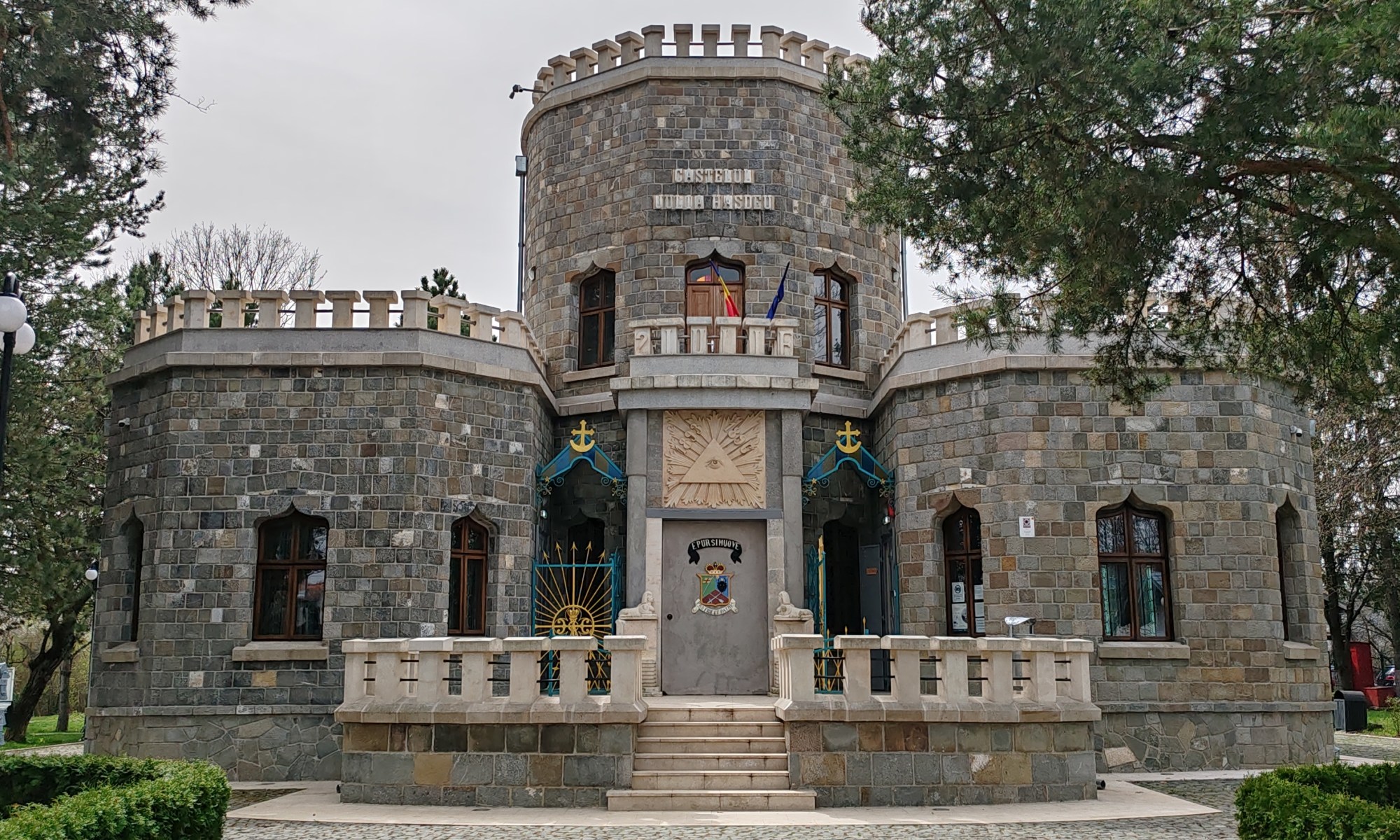
In the 19th and 20th centuries, it was also home to several important cultural figures of the time, such as painter Nicolae Grigorescu (1838-1907), famous mainly for his romantic depictions of rural life. Grigorescu’s house has survived to this day, and can be seen proudly standing watch at one end of the Carol I Boulevard in Câmpina. At the other end, surrounded by a tall and rather dramatic golden fence, stands the unusual building I want to talk about here, which has been dubbed the “Iulia Hașdeu Castle” (pictured above).
This building, which looks like a Neogothic castle in miniature, is an odd sight indeed among the traditional Romanian houses either side of the boulevard, with its glaring esoteric symbols, such as the enormous Eye of Providence set just above the main entrance, and the two sphynxes flanking its massive metal door.
This “castle” was built (between 1894 and 1896) by another famous Romanian of the 19th century, the writer, historian and politician (of liberal leaning) Bogdan Petriceicu Hașdeu (1838-1907). Hașdeu was very active as a historian and writer, and authored the first “critical history” of Romania, though he had some tendencies towards “bending” the facts, having falsified some historical documents while pretending to have discovered previously unknown papers allegedly dating back to the 14th century. He adopted his middle name, “Petriceicu”, in an effort to suggest that his family bloodline was descended from a 17th-century Moldavian prince bearing that surname.
He was an odd character, that’s for sure, and perhaps he had some delusions of grandeur, but he appears to have been a devoted father to his only child, a daughter, Iulia. (You’re probably starting to see where this blog post is headed now!) Born in 1869 – and, I believe, named after her own mother, who was also called Iulia – she had access to the best education. As a child, she studied music at the Conservatoire, and was enrolled in the prestigious Saint Sava National College in Bucharest, which had been founded in the 17th century as a Royal Academy and maintained its status as an elite school. (It has maintained its prestige to this day and, full disclosure: I attended high-school there.) Iulia graduated from Saint Sava aged 11, and later, when she was in her teens, her father sent her to continue her studies in Paris, where she eventually attended Sorbonne. By all accounts, she was an extremely well-educated young lady of means, with a promising future ahead of her. You probably already know what I’m about to say next though: poor Iulia didn’t get to see what life may have held in store for her. While in Paris, in 1887, she contracted tuberculosis, known as “consumption” at the time. Despite her father sending her to Switzerland to receive some of the best healthcare available at the time, her condition never improved and she passed away a year later, in September 1888, at the young age of 18. Her fate was, sadly, a common one: by the end of the century, up to 90% of the urban populations of Europe and North America had at one point contracted the virus that caused tuberculosis, and some 80% did not survive. In short, “consumption” was one of the top causes of death that century.
Sad as this all is, it is what happened next that is equal parts fascinating and disturbing, as one could well say that Iulia Hașdeu’s “life” and, most certainly, her career, only truly began after her death. Perhaps needless to say, her father was distraught at the news of his beloved daughter’s death. So much so that, in an effort to claim back the life that had so brutally been snatched away, he did what many other grieving parents or widowed spouses of high society did at the time, namely, turned to Spiritism, which gave him the hope he’d be able to communicate with the spirit of his daughter from beyond the grave. Through various séances with Spiritist mediums, as well as his own individual practice of automatic writing, Hașdeu the father came to believe he had established contact with the spirit of his daughter.
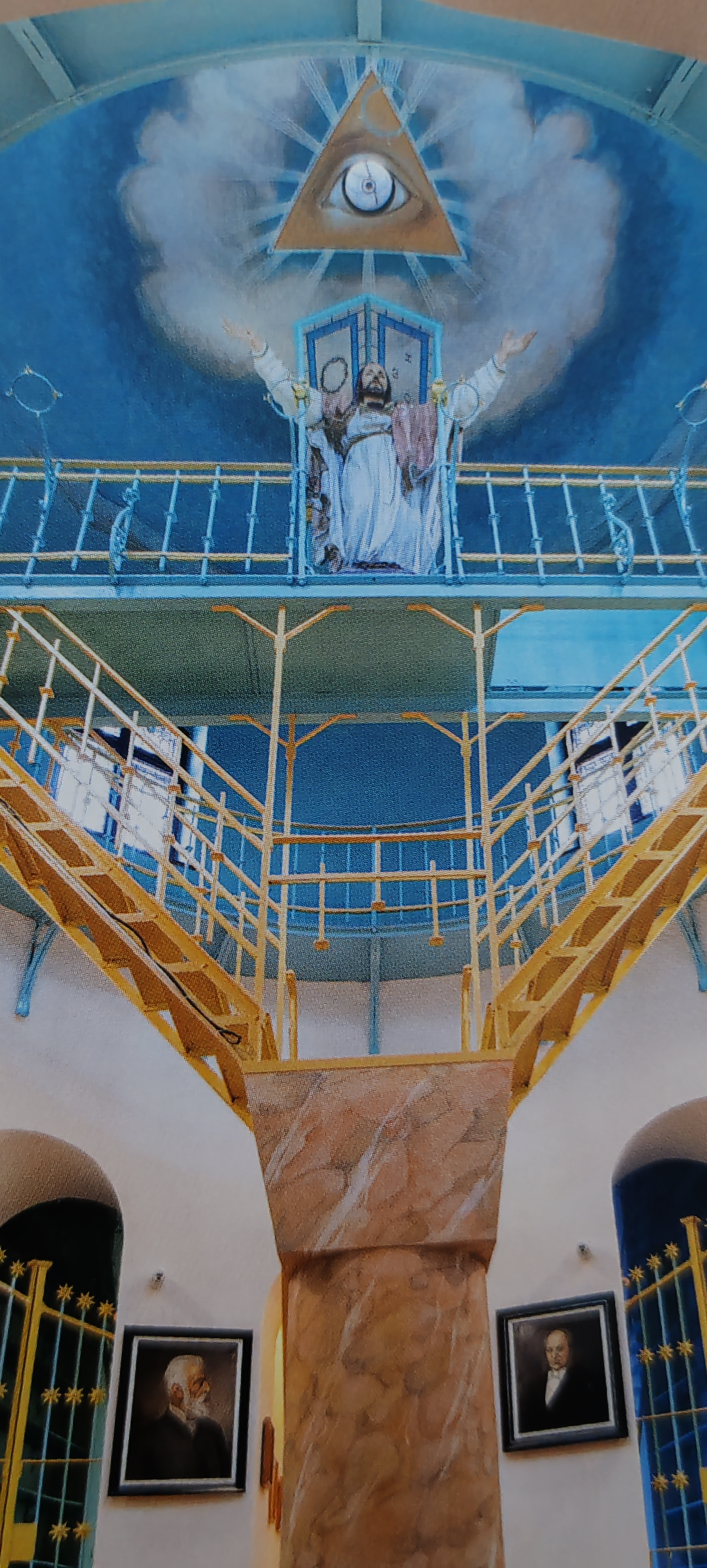
To a great extent, of course, he found this practice soothing, as he became convinced that his daughter was sending him messages suggesting she had attained a beatific state. Notes from these séances claim the receipt of messages from the Great Beyond reading “father, don’t worry, I’m happy” and “before death you are nothing, and after death you are finally becoming something“. And on that latter pronouncement hinges everything that came next, that is, the great and disturbing “dead girl cult” that Hașdeu proceeded to establish for his daughter. During some séances, Hașdeu “received” the architectural plans, allegedly devised by his dead daughter, of a wonderful Spiritist temple that he was meant to build. And build it he did: this is how the “Iulia Hașdeu Castle” in Câmpina came to be. The odd Neogothic structure stands out through its dark, foreboding aspect, but it is otherwise not a grand building in any way: iniside, it only consists of an antechamber, some five rooms and a handful of alcoves. Yet the interior – where photography is now strictly forbidden – is even more unusual than the exterior. After the antechamber, a so-called living-room painted with cadaveric-looking frescoe portraits of the entire Hașdeu family leads into the main hall, Hașdeu’s “Spritist chapel”. This is perhaps the most unsettling room of this “temple”, as a monumental Jesus painted in garish colours presides over the room from high above, suspended close to the eye-shaped cupola through the means of a chalice-like structure, symbolising (rather sexuallly) the divine feminine. The main entrance to this “chapel” is set so that the person entering had to pass between parellel mirrors replicating their image to infinity, meant to purify and sanctify the guest, casting out all negative energies.

From the “chapel”, one passes straight into a large study where Hașdeu the father liked to sit down to work (and, presumably, engage in feverish sessions of automatic writing). To the left of this study, a smaller room whose walls are lined with a calla lily wallpaper in soft blue and turqoise hues, makes a sort of “memorial chamber” dedicated to Iulia, and various mementoes of her are now on display there, including a well-loved porcelain doll and, unsettlingly, various sketches or copies of drawings of Iulia’s corpse lying in state. There is also a large black slate on show, featuring the musical notation for a piece entitled Sursum, to which I shall come back momentarily.
To the right of the study, there lies the inner sanctum, the so-called camera obscura, where the Spiritist séances would take place. It is also the room where Hașdeu developed the photographic plates for his “spirit photos” (literally photos he took that he believed captured spiritual entities). The camera obscura is linked to the study by a narrow hallway, but one can also peep inside it right from the study, unusually, through a large hole in the wall. It is unclear what this room used to look like, as, ironically, no photographic documentation of it exists. But the memoirs of Hașdeu’s contemporaries suggest it was painted dark colours, and two surviving but badly damaged frescoes, depicting the head of a cherub and an inverted triangle, further suggest it was once decorated with esoteric symbols.

But what about “before death you are nothing, and after death you are finally becoming something” and Sursum? Grief-stricken as he was, Hașdeu not only attempted to “prolong her life” by establishing contact with her spirit via séances, but he also set about creating what I can only refer to as a “post-mortem career” for Iulia. First, he collected what he could find of her writing – she appears to have been rather a prolific writer, having authored dozens of poems and children’s stories – edited it, and had it published posthumously. A famous portrait of Iulia, a copy of which now stands in the temple’s “living-room”, which her father commissioned after her death, of course, depicts her clad in white, standing in a meditative pose “in the library”, her left hand resting on an open book, surrounded by other objects suggestive of her talents, namely the lyre (music), a Globe (perhaps suggesting her wide area of knowledge), and a stack of three books – the three poetry collections her father posthumously published for her.
He didn’t stop at publishing her actual work posthumously, however. As we saw with the plans for the Spiritist temple at Câmpina, he was apparently convinced that Iulia’s spirit was a great architect (and possibly theologian). He also thought she composed music after death, which she communicated to him during séances. That is what Sursum, the musical piece displayed in the calla lily room is supposed to be: a piece she composed in the afterlife, which he adopted as the Spiritist temple’s “hymn”. (I believe you can listen to some of it here. It’s a rather funereal piece, as expected.)
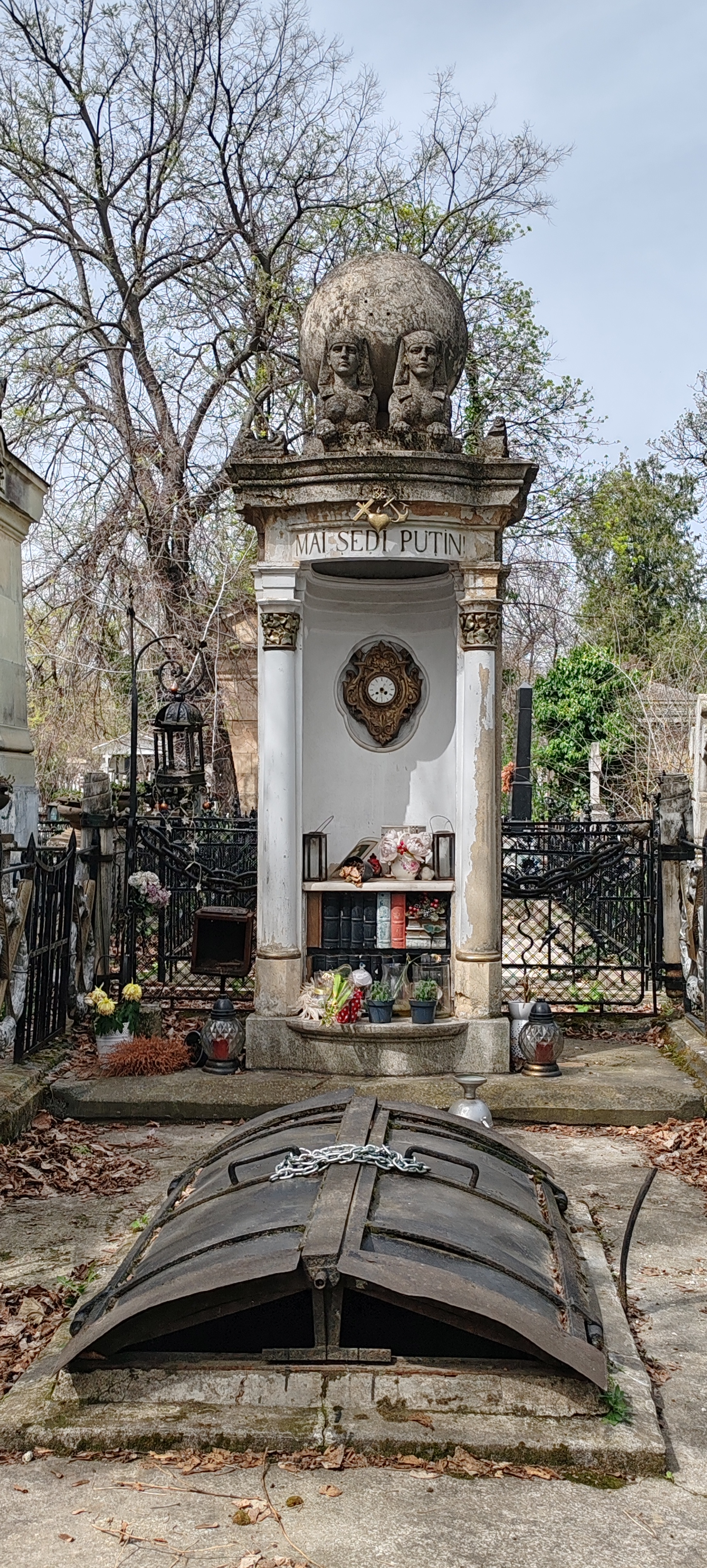
The thing is, Hașdeu did such a great job of constructing this image of a child-prodigy daughter, talented and intelligent beyond her years, whose creativity continued to develop even after her death, that it has become deeply embedded in cultural narratives about Iulia Hașdeu. Was she intelligent and creative? Perhaps. Is it likely that her father exaggerated her talent and perhaps even edited some of her writing to “spruce it up”? I would say yes. Nevertheless, it’s understandable that a deeply grieving parent would fantasise about what his daughter might have achieved had she not died at such a young age. However, what I find the most striking and disturbing, is the almost fetishistic nature of the cult Hașdeu built around his daughter.
Many years ago, when I was tween, and I first went to visit the “Iulia Hașdeu Castle” at Câmpina, the building had fallen into disrepair, and you could barely make out what the interior was meant to look like. The temple had itself almost become a grave, and I found myself wishing the apparition of the dead Iulia would rise triumphantly from it, put pen to paper and write a poem about the transitory nature of all things. However, when I visited again recently, the “temple” had been restored to its former glory, inside and out, which is great, but also made me finally see how jarring the garish colours and esoteric kitsch were in the context of preserving the memory of a young woman who never got to grow up and become her own person, so to speak. Instead, she got to be “preserved” like her childhood porcelain doll in a glass case, a half-child forever, a blank canvas on which a grieving old man got to project his increasingly morbid fantasies.
Having visited this temple, allegedly built for Iulia, I was left with a bitter taste, and a sense that we’ll never know who Iulia was, what she was actually like because we got a painted idol instead.

 Encyclopaedia Vanitatum
Wonderfully put! I really enjoyed reading this, thank you!
div>
Florian Mitrea
div dir=”ltr”>
blockquote type=”cite”>
Thank you, so glad you enjoyed it! x