

For the past couple of months or so, if not longer, the media has been awash with rave reviews of Robert Eggers’ version of Nosferatu, which was due to be released in the States in December, and was released in the UK on the 1st of January. The push to promote this $50 million-budget film was extraordinary but I was suspicious of it from the start.
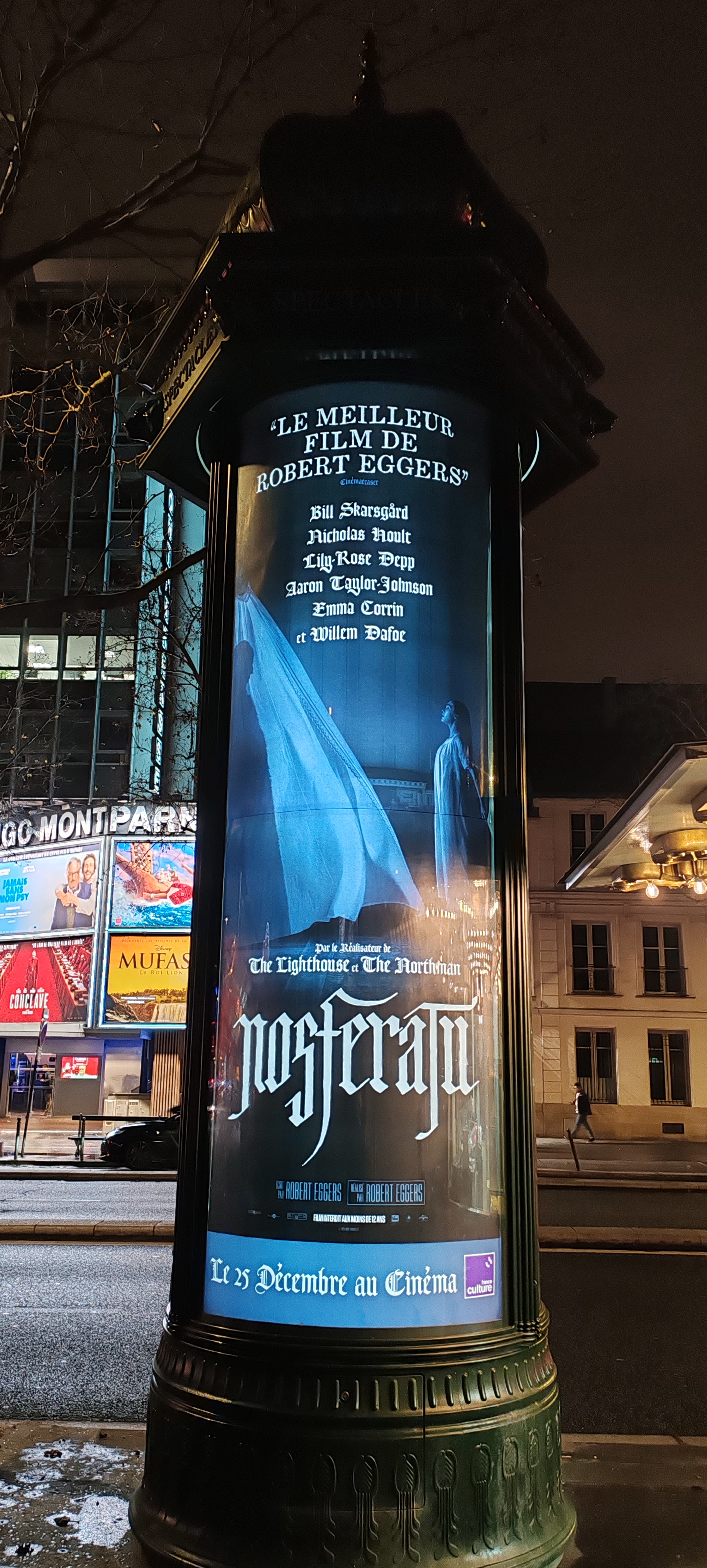
I did wonder what a Hollywood remake of Murnau’s Expressionist original was aiming to achieve but more than that, the early interviews that Eggers gave about this film gave me pause. He bragged extensively about his “research” on Romanian culture and customs, but the things he actually said about their portrayal in his film made me worry about the very real potential of stereotypisation.
I went to watch his Nosferatu today, and it was so much worse than what I had anticipated. My fears came true and then some. I left the cinema feeling so offended, I was shaking with rage.
This film is, hands-down, the most racist, xenophobic, and sexist work I have chosen to expose myself to in a while. Strap yourselves in, and please be aware that film spoilers will follow.
[For those who don’t want to read through the spoilers, here’s my summarised assessment: the anti-Roma racism, the inaccurate and downright offensive portrayals of Romanian culture, the use of made-up Dacian, equating a vague Eastern European space with madness, savagery and infectious disease, the sexist fantasies of self-destructive female sexuality, meaningless necrophilia, poor characterisation, and overall chaotic plotline made me want to stand up and leave several times.]
Right, where do I even start with this utter dumpster fire? Maybe with the thing that puzzled me in the beginning: the film starts with Nosferatu (Count Orlok) communicating with Ellen in a language that I couldn’t exactly recognise. He uses this language several times throughout the film, and it sounds like a mix of garbled Latin and almost-Romanian, so I wondered if it was some poor attempt at some kind of proto-Romanian. Turns out, I was half-right: apparently, Eggers was aiming for Dacian, a language spoken in that geographical space around the 1st-2nd centuries CE, before the Romans conquered Dacia, starting an assimilation process that would become the first step in the eventual development of Romanian cultures and dialects. Thing is, insofar as I’m aware, no one actually knows what Dacian sounded like, exactly. There aren’t any clear records of it. The few Romanian words that linguists have concluded likely come from Dacian tend to be associated with hunter-gathering and agricultural pursuits, and have little or nothing in common with Latin, so the garbled “Latinomanian” used in Eggers’ film is not only fully made up but, I believe, made up with little regard for actual linguistics, its only purpose being to render Count Orlok as exotic as possible.
Speaking of exoticism: this film’s portrayal of Romanian culture and a very vague Eastern European space is offensive to say the least. Despite bragging about doing his due diligence researching the culture, history, languages, and customs of Romania, despite apparently hiring Romanian consultants for the film, the result was still an offensive mishmash of racist stereotypes and tired clichés. When Thomas Hutter (the Nosferatu version of the original Jonathan Harker from Dracula) reaches an anymous Romanian village in the “Carpathian Alps” on his way to Count Orlok’s castle, he is immediately surrounded by a mad and dizzying crowd of overexcited Roma children, immediately followed by a baffling episode where a Roma woman launches into a seductive dance for no reason. The entire village, populated by what appears to be a mix of ethnic Romanians and Roma Romanians comes across as utterly demented. A later scene depicting the ritual of eliminating a strigoi (a revenant creature from Romanian folklore, often likened to a vampire) inexplicably centres on said Roma woman riding a horse stark naked to the cemetery, surrounded by the village folk. I hope I don’t need to spell this out, but this is all so ridiculous, so divorced from any actual superstitions or customs, that the only message it sends is that of anti-Roma racism and sexism: look at these savage, barbaric people and their inexplicable, erotomaniac customs.
Later in the film, there are scenes depicting Orlok’s voyage by sea to the Western (German, in the film) town of Wisborg. Inexplicably, though Orlok has departed from a Romanian space, and the languages spoken there had been Romanian and Romani, now the entire crew of this ship (which presumably also sails from that same para-Romanian space) speaks, from what I can tell, Russian. Was this a random choice? The film regales us with a mix of languages vaguely associated with Eastern Europe (Romanian, Romani, Russian, a made-up Latin-ish dialect) to create the feeling of an Othered, Euro-Oriental space, home to ancient demons and superstitions. (Interestingly, though Wisborg is supposed to be German, no Western European languages other than English are spoken in this film.)
A scene of exorcism performed on Thomas by Romanian Christian-Orthodox nuns in an Orthodox monastery is also baffling: not only does the head nun don a priestly robe, which seems blasphemous as per Orthodox practice, but nuns would probably be the last called on to perform an exorcism rite (priests might do it, but more often than not elder laywomen would). Not to mention that, to my knowledge, exorcism is and has always been a contested practice in Orthodoxy, since it comes dangerously close to magical practices that are frowned upon in this branch of Christianity.
On a related note, Orlok’s devoted follower in Wisborg, Herr Knock, is described as a solomonar – abysmally mispronounced by Dafoe playing Prof. Albin Eberhart Von Franz, as it took me a while to figure out what he was saying. In Romanian folkore, a solomonar was a sort of medicine man with magical powers, often the power to control the weather and commune with mythical creatures of the Underworld. In Romanian folklore, they are complex characters, so seeing them associated with the figure of a deranged, pigeon-beheading estate agent was dissonant in more ways than one.
What of Orlok then? Despite all the rave reviews sugesting that Eggers had done something wildly innovative with this character by portraying him as an “actual corpse” (*gasp*), on screen he looked so ridiculous, I kept laughing out loud in the cinema. The vibe he gave was more sad Hollywood zombie than credible reanimated remains of Transylvanian nobility. Also, deep inside, I was hoping Eggers would go some way towards questioning or contextualising the original Dracula and Nosferatu narrative of the monstrous foreigner from a backwards country bringing death and disease to the civilised West. No such luck. His remake only replicates that, with Orlok bringing ciuma (pestilence) to Wisborg by way of thousands of disease-carrying rats (and Eggers brags that he used 5,000 real rats on set, which seems completely unnecessary in the age of realistic animation and special effects).
Not only is this film racist and xenophobic, but it also let me down on the portrayal of female characters front. While the idea is, I guess, that Ellen (Lily-Rose Depp’s character, and the equivalent of Mina Harker in Dracula) takes centre-stage in defying the patriarchal system at play and eventually defeating Orlok, she effectively remains a puppet in an essentially misogynistic theatre. No matter how I look at, or try to read her character, it still comes out wrong:
- Is she a “primal creature that is susceptible to the influence of demons”, as Prof. Von Franz suggests? That approach reeks of Madonna/whore dichotomy.
- Did her loneliness after her mother’s death and her desire for affection wake up Orlok from his hundred-year sleep and bring his deadly presence to the town? Then women are essentially flawed in this worldview.
- Is she entirely blameless, a mere victim of the patriarchal system, passed around from male hand to male hand, from husband, to husband’s friend, to doctor, to another doctor, to vampire? If so, then the ending is all the more troubling, as she never manages to free herself from this patriarchal system. Her only choice is not an act of self-determination but the fate already prescribed to her, that of self-sacrifice, so she may preserve the lives not of her dear friend and her daughters (already dead) but of the men in her life. The ending was thus completely unsatisfactory: patriarchy prevails at the cost of female lives already doomed to suffer and die.
Oher choices were also troubling, suggesting that much of this film was nothing more than a male fantasy of dark, unscrutable female sexuality, and an exercise in extreme sexual objectification. The relationship/dynamic between Ellen and her best friend, Anna, is never properly developed or explored; they are like puppets dancing around each other for most of the film. One scene hints at something vaguely sapphic, when the two of them share a bed one night – but rather than exploring the strong bond of female friendship, or any actual sapphic attraction, the scene remains vaguely titillating for the male gaze only, with no further development.
The gratuitous, meaningless necrophilia also gave me pause: a pestilence-infected Friedrich Harding breaking into the vault where his dead wife and daughters had been laid to rest, only to sexually defile his dead wife’s body and proceed to die on top of it; and of course, the final scene where a naked Ellen dies embracing the decomposing (also naked) body of Orlok. Such themes can and have been explored meaningfully and a lot more interestingly in other films, but in Eggers’ Nosferatu they are devoid of all meaning, contributing nothing to the film.
The only thing this film excels at is the disgust factor – there is an abundance of the abject but it fails to create a sense of dread, unease, horror, or terror. It remains disgusting in the same way that a discarded, rotten meal in the middle of a clean kitchen floor is disgusting.
I was also not blown away by most of the acting – other than Depp’s contortionist feats, which she apparently trained really had to achieve, she delivers her lines in an artificial, jarring manner, as do the other actors. It also doesn’t help that she says she studied “19th-century hysteria patients” to achieve the visual effect of her character’s convulsions, given that hysteria was a fake disorder, a patriarchal gimmick designed to brand uterus-bearers as inherently mentally unstable, and thus to preserve the status-quo.
A lot of the acting and the character portrayal, particularly but not only, that of Orlok, struck me as caricaturish, and while these exaggerated portrayals were characteristic of Expressionism and sat well within Murnau’s original, achieving an operatic effect, in Eggers’ remake they are merely ridiculous.
Yes, the film did achieve an atmosphere that was overall pleasantly Gothic, with beautiful grayscale shots, with numerous nods to Murnau’s etshetics and the striking minimalism of Caspar David Friedrich’s brand of Romanticism. However, that was but to be expected in a film with such a huge budget, and it did little to make up for the offensive grotesqueness that otherwise characterised the film. Not to mention it was boring, to boot. Even the jump scares were boring.
Conclusion: using a country’s language and filming on location are nowhere near good enough if you want to prove real cultural awareness. Using a few token actors and advisors is meaningless if you then still proceed to regurgitate bizarre stereotypes. A big ego and lots of money do not a good director make. Shame on Eggers for this pile of garbage.
 Encyclopaedia Vanitatum
thankyou for this. I thought I was going crazy with all the hype and praise. It’s the whale/poor things/saltburn rinse and repeat.